UNIT 17 · Case Study
Iki
MIT-licensed 2D rig engine for the web, with an MCP server and a Claude Code plugin that let an AI agent rig a character from layered art.
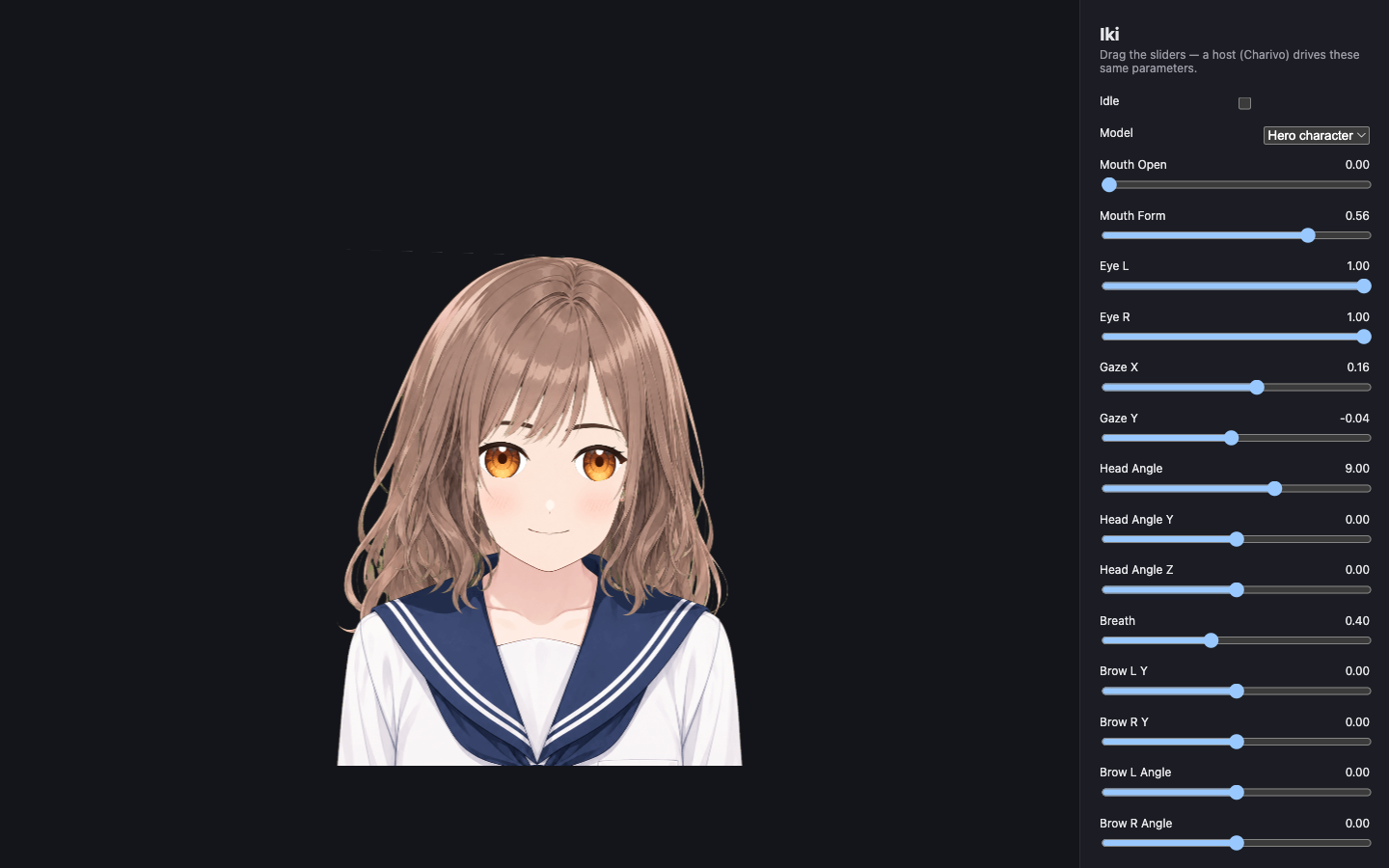
Iki (息 breath · 生き life · 粋 chic) is a 2D puppet rig engine for the web, and an AI agent can build its rigs: give it a character’s art as separate layers and a rigged, animated model comes back. Live2D Cubism is the industry standard and Inochi2D the established open alternative. I made Iki because I couldn’t find a permissive license, a plain-text format, and a rig an agent can build in one place.
An agent does the rigging
- What goes in: transparent PNG layers named by role, or one layered PSD in the editor.
face,eye_L,eye_Randmouthare required; irises, brows, lashes, nose, hair, and body are optional. - What comes out: a validated
.ikimodel that blinks, gazes, lip-syncs, turns, nods and tilts its head, and moves its brows, with hair swaying on physics. On a turn the nose leads, the features slide across the face, and the back hair trails behind, so it reads as a head rotating rather than a cutout sliding. - How an agent drives it: the
@ikijs/mcpserver exposesauto_rig_from_layers, pluscompose_layers_from_partsto place generated part images on a shared canvas andmeasure_layers, a geometry report that catches an iris the wrong size for its eye or a cropped edge before it costs another round of image generation.
The Claude Code plugin bundles the server with two skills: a single pass from a text description to a finished .iki, and a generator/critic loop in which an artist agent draws and re-rigs while a critic agent scores the render against a reference image until it’s worth shipping.
/plugin marketplace add zeikar/iki
/plugin install iki@iki
What a rig is made of
That only works because the model is small and readable. A .iki file is one JSON document, textures included, and it’s made of:
- Parameters. Named, ranged values like
ParamAngleXorParamEyeLOpen. A standard set of sixteen ids lets any host drive any model without wiring it up per model. - Parts. Quads or triangle meshes cut from a texture atlas, moved, rotated, scaled, and faded by parameters through linear bindings.
- Deformers. Pivoted matrix deformers in a parent hierarchy, plus warp grids with keyforms, including 2D grids that blend a head turn with a nod.
- Clipping masks. Stencil-based, so an iris clipped to its eye white never spills out at extreme gaze.
- Physics. Spring-mass-damper rigs and multi-segment gravity chains for hair.
The validator fails fast and names the exact path, e.g. parts[3].mesh.indices[12] 40 is out of range, so an agent can check its own output. The WebGL2 runtime depends only on the format and knows nothing about its host, which sets parameters from lip-sync, gaze, and expressions while the engine’s motion driver handles idle blinking, breathing, and physics.
Using it
The format, engine, a headless editing core, and the MCP server are on npm under @ikijs. The playground moves a generated character with the same sliders a host would drive. The editor authors parts, deformers, and physics rigs and exports a validated .iki. It’s still early and the schema is settling; for production-grade rigging today, use Cubism.
Charivo dogfoods it through a private render-iki adapter that its CI builds against Iki’s published engine; Charivo’s published renderer and demos still use Live2D.